Step-by-Step Flooded Basement Cleanup Protocol
- Stop the source (0 to 15 minutes). Shut the main water valve if the cause is a supply line. For sump pump failure, unplug the unit and verify the breaker. For groundwater intrusion through a Trafalgar foundation wall, you cannot stop the source, so move directly to step two. For sewage backflow, do not enter the water. Call our sewage cleanup team immediately because Category 3 water requires PPE and containment.
- Cut electrical power to the affected level. Throw the basement breakers at the main panel. Do not step into standing water with energized outlets within 18 inches of the surface.
- Document everything before extraction. Photograph water lines on walls, submerged contents, and the source. Note the time. This documentation drives your insurance claim. Our review of basement flooding cleanup procedures covers the exact photo angles adjusters want.
- Categorize the water under IICRC S500. Category 1 is clean supply line water. Category 2 is gray water from appliances or seepage. Category 3 is sewage or floodwater containing pathogens. Category determines whether materials are dried or demolished.
- Classify the loss (Class 1 through 4). Class 1 affects part of one room with low porosity materials. Class 2 saturates an entire room including carpet. Class 3 includes saturated ceilings and walls. Class 4 involves deeply saturated materials like hardwood, plaster, or concrete. Class drives equipment count.
- Extract standing water. We deploy truck-mounted or portable extractors rated at 150 to 200 PSI with 15 to 25 gallon waste tanks. Target removal rate: 1 inch of water across 500 square feet in roughly 30 to 45 minutes per crew member.
- Remove unsalvageable materials. Carpet pad in Category 2 or 3 water is always discarded. Drywall is flood-cut at 12 inches above the highest water line, or 24 inches if insulation is saturated. Baseboards come off and get bagged. Wet insulation (fiberglass or cellulose) is removed in full.
- Clean and disinfect all affected surfaces. For Category 2 and 3 losses, we apply an EPA-registered antimicrobial. HEPA-vacuum first, then apply per label dwell time, typically 10 minutes.
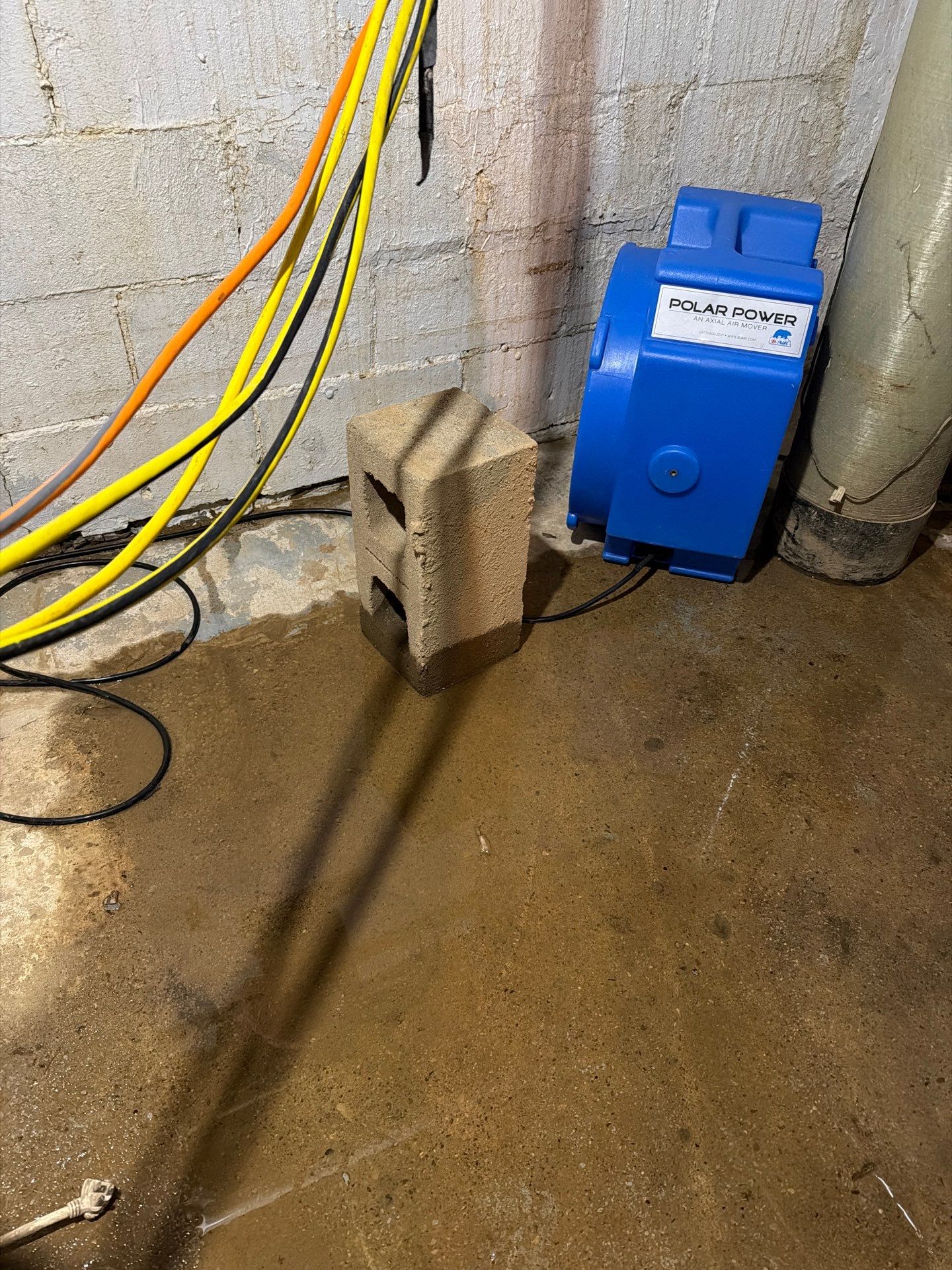
- Set primary drying equipment. Standard Trafalgar basement of 800 to 1,200 square feet typically requires 6 to 10 air movers (rated 2,800 to 3,200 CFM each) plus 1 to 2 LGR dehumidifiers (rated 130 to 250 pints per day at AHAM). Air movers are placed at 10 to 16 foot intervals, angled 15 to 45 degrees off the wall.
- Establish drying chamber and monitor daily. We seal off stair openings with 6 mil poly to create a controlled chamber. Daily readings include temperature (target 70 to 90 F), relative humidity (target under 50%), grain depression (target 30 to 40 grains per pound), and moisture content of materials via penetrating and non-penetrating meters.
- Verify dry standard. Concrete should read under 4% moisture content. Framing lumber should reach 12 to 15% or match unaffected reference areas within 2 percentage points. Drywall should read under 1% on a non-penetrating scale.
- Remove equipment and perform post-remediation verification. We document final readings, photograph the dried space, and provide a written drying log. If mold growth was suspected, third-party air quality testing is recommended before reconstruction.
- Reconstruction phase. Replace flood-cut drywall, install new baseboards, lay new carpet pad and re-stretch carpet (or install replacement flooring), repaint, and reset any displaced contents.
Equipment Specifications and Placement Rules
- Air mover output. Centrifugal units deliver 2,800 to 3,200 CFM at low static pressure. Axial units push 3,000 to 3,400 CFM and are preferred along long wall runs in Trafalgar basements with open framing.
- Dehumidifier sizing. Calculate cubic footage (length x width x height), then divide by the AHAM rating class factor. Class 2 losses use a factor of 40, Class 3 uses 30, Class 4 uses 20. A 9,600 cubic foot Class 3 basement needs 320 pints per day of dehumidification capacity, met by two 170-pint LGR units.
- Power load planning. Each air mover draws 1.8 to 2.5 amps at 115V. Each LGR dehumidifier draws 7 to 9 amps. A 10 air mover, 2 dehumidifier setup pulls roughly 40 to 45 amps and must be split across at least 3 separate 20 amp circuits to avoid breaker trips.
- Containment materials. 6 mil poly sheeting, painter's tape, and zipper doors maintain the chamber. Negative air machines with HEPA filtration (500 to 2,000 CFM rated) are added for Category 3 losses.
Insurance and Documentation Specifications
- Sudden and accidental discharge (burst pipe, appliance failure) is typically covered under standard HO-3 policies. Groundwater and surface flooding require separate flood insurance.
- Submit photos, the source diagnosis, IICRC category and class, daily moisture logs, and an itemized scope. Trafalgar Water Restoration provides all of this in Xactimate-compatible format.
- Request your deductible amount and policy limits before signing any work authorization. Compare cost expectations using our water damage restoration cost breakdown so you walk into the adjuster call informed.
- Mitigation work (steps 1 through 11 above) is almost always covered when documented. Reconstruction is covered subject to policy terms.
- Notify the carrier within 24 to 72 hours of discovery. Most policies include a prompt notice clause, and delays beyond 7 days can trigger partial denial.
- Request a copy of the adjuster's scope after inspection. Compare line items against the Trafalgar Water Restoration estimate. Discrepancies in drying days, air mover count, or antimicrobial application are the most common areas to challenge.
- Keep receipts for any temporary lodging, replacement essentials, or contents cleaning. Loss of use coverage typically reimburses $150 to $300 per day during uninhabitable periods.
Exact Cost Ranges for Trafalgar Basement Cleanup
- Category 1, Class 1 (clean water, small area): $1,200 to $2,800. Extraction plus 3 days of drying, no demo.
- Category 1 or 2, Class 2 (full basement, carpet pad removed): $3,500 to $7,500. Includes pad disposal and 4 to 5 days of drying.
- Category 2, Class 3 (saturated walls, flood-cut drywall): $7,500 to $15,000. Demo, antimicrobial, structural drying, debris haul.
- Category 3 sewage backup, Class 3 to 4: $10,000 to $25,000+. Full containment, PPE, hazardous waste disposal, deeper demo.
- Reconstruction (separate phase): $4,000 to $20,000 depending on finishes and square footage.
- Emergency after-hours response fee: $250 to $500 surcharge for arrivals between 8 PM and 6 AM, weekends, or holidays.
- Equipment rental extension: $75 to $150 per air mover per additional day, $150 to $250 per dehumidifier per additional day if drying exceeds the original scope.